With the presence of stains and mold spots on the wood and rust on the…
Is my co-ownership affected by the maintenance logbook requirement?
The maintenance logbook is now a mandatory tool for all divided co-ownerships (condominiums) in Quebec. It serves as an essential reference to ensure the preservation of the building, to plan necessary work, and to protect the co-owners’ investments. But who exactly is subject to this requirement, and are there differences depending on the type of condominium? Stay with us as we take a closer look at the new obligations introduced by Bill 16 regarding the maintenance logbook.
Need a maintenance logbook co-ownership?
Our condo specialists are there to help you
simplify the managment of your co-ownership!
A Requirement for All Divided Co-ownerships
The regulation adopted by the Quebec government clearly states that all divided co-ownerships must have a maintenance logbook. This requirement applies to both large residential towers and smaller buildings converted into condos. Regardless of the number of co-owners or the building’s purpose, the principle remains the same: past interventions, the condition of common areas, and planned work must be recorded clearly and in an organized manner.
The logbook thus becomes a universal management tool, ensuring that every condominium syndicate has a clear understanding of the building’s maintenance and long-term durability.
Differences Based on the Building’s Size and Purpose
While all condominiums are included, the regulation provides for adjusted requirements regarding the review of the maintenance logbook by a qualified professional.
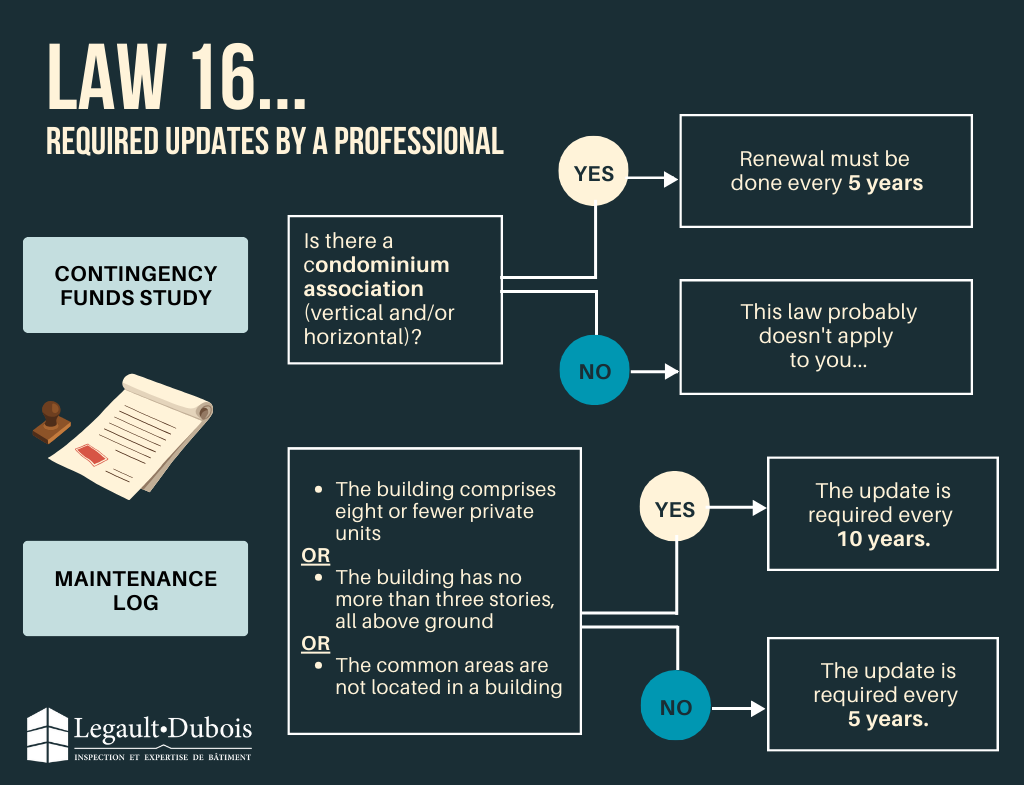
- General rule: the logbook must be reviewed at least every five years. This review involves examining the information recorded, verifying its accuracy, and updating the document based on the building’s actual needs.
- Exception: for smaller condominiums, the requirements are relaxed. To qualify for this exception, the building must meet at least one of the following three criteria:
- The building contains eight private units or fewer, excluding parking spaces, storage areas, or other accessory private portions.
- The common areas are not located within a building.
- The building has no more than three storeys entirely above ground.
If any of these conditions apply, the logbook may be reviewed only every ten years instead of every five. This flexibility reflects the fact that small residential buildings generally present less complexity and simpler maintenance needs.
But be careful—do not confuse the logbook with the reserve fund study. The reserve fund study must be updated every five years, regardless of the building’s configuration or whether the syndicate is vertical or horizontal.
Practical Consequences for Condominiums
In large residential or mixed-use buildings, the obligations are therefore stricter: a five-year review by a professional is essential to ensure that maintenance remains aligned with the building’s actual condition.
For smaller residential condominiums or certain horizontal co-ownerships, a logbook is still required, but the review frequency is reduced. This helps lower costs for co-owners while maintaining a minimum level of oversight.
The maintenance logbook is mandatory for all divided co-ownerships in Quebec, but the review frequency varies according to the building’s size and purpose. This distinction helps balance the protection of shared real-estate assets with the financial capacity of condominium syndicates.
If you are still unsure how to comply with the requirements of Bill 16 regarding your condominium’s maintenance logbook, feel free to contact us. Our specialists are here to provide the information and services you need quickly and easily!
Need a maintenance logbook co-ownership?
Our condo specialists are there to help you
simplify the managment of your co-ownership!
Related Posts